
The Supreme Court from Hell (No.6): Court Cements Tocqueville's "Tyranny of the Majority"
The decision to strip voting rights privileges just one group: WHITES. We were all warned.

Our deepest thanks go to those of you who support us with your monthly and yearly subscriptions—or a very divine founding membership. If you’re not already a paid subscriber, we hope you’ll consider becoming one—as the more support we have, the more we can write.
Alexis Charles Henri Clérel, Comte de Tocqueville (1805-1859) was a French aristocrat, member of the French National Assembly and the Chamber of Deputies and one of the West’s earliest and most influential political scientists. After a trip to America in the early 1830s, he arrived home in France with a mountain of handwritten notes, and then authored the groundbreaking Democracy in America in two volumes in 1835 and 1840. According to Joshua Kaplan, one of his several purposes in writing Democracy in America was to prepare the French to deal effectively with the confusing shift going on between its past— a fading aristocratic order—and its emerging democracy.
Joshua Kaplan (2005). “Political Theory: The Classic Texts and Their Continuing Relevance.” The Modern Scholar. Fourteen lectures: lectures #11 & #12 – see disc 6.
The most spectacular passages in Democracy in America, however, are the messages for America herself, and likely for every powerful representative democracy that will follow—or survive—her. Tucked in Chapter XV of Book One is his staggeringly prescient discussion of the deadly risk in democracies of The Tyranny of the Majority.
Tocqueville writes:
Despotism lies at both extremes of sovereignty: when one man reigns, and when the majority governs. Despotism is tied to omnipotence, whatever its bearer. … The omnipotence of the majority seems to me the greatest flaw of democratic governments and the source of their most serious dangers.
Tocqueville seemed to think that this was an either-or situation: either the despot was a sovereign or the majority was the despot. This would not prove true in our time.
The Trump Circle of Hell
When de Tocqueville visited America almost 200 years ago, the great experiment was a mere 50 years old. As we’ll see, the French philosopher wouldn’t be able to see everything coming and would misunderstand the American court system in a way that would lead to a few misconceptions; on the other hand, he would see the broad brushstrokes of our fate in paint that was barely dry.
And where are we now? In a deadly triple confluence:
At the helm, an unchallenged autocrat of limited intellectual capacity and destroyed emotional balance—a selfish, self-centered, narcissistic, cruel rapist and fraudster, prone to capricious and dangerous actions against individuals who challenge him and nations with something he wants or something he can use to deflect from credible claims of his wrongdoing. Reminding him that statues that Nero and Commodus erected to themselves in the Coliseum and the Forum no longer exist—Commodus’s destroyed in the 3rd century CE and Nero’s, in the 5th—don’t seem to stop the grand self-aggrandizer from trying to build a tawdry ballroom and erect an arch, the design of which is a European rip-off.
The winds beneath this false god’s wings are an ultra-conservative White Christian Nationalist religious sect dedicated to supporting him to achieve racial and gender apartheid and domination and to establish a religious state in which, contrary to the settled policy of separation of church and state, everybody has to say, think, and read what they approve and make love in the ways they sanction. Part and parcel of maintaining White majority in America will be the complete subjugation of women to the level of breeding animal. Afghanistan has the highest birth rate in the world right now, because women are allowed nothing else and are not able to refuse the sexual demands of husbands. (By law, men can deny women food if they do.) Afghan women also have the highest rate of maternal deaths in childbirth of any group of women in the world. There is a reason Christian Nationalists are called, by some, the American Taliban.
Fatefully, our highest-level court, spiked with the liquors of Alito, Thomas, Kavanaugh, Coney Barrett, and Roberts, seems intent upon dismantling the rule of law, gutting voting rights of minorities, blocking women from basic rights afforded all citizens in this culture, decimating freedom of knowledge (access to all literature), suspending freedom from torture, summary deportation, and arbitrary seizure of legal citizens’ rights of residence, and removing protections against arrest without warrant by masked police so violent they have killed.
It seems as if de Tocqueville was not seeing America prone to creating the kind of fanatical religious state cum oligarchy we are suffering now: he seemed to trust religion as a kind of social and cultural cement, “a safety valve for passions that might otherwise feed a revolutionary torrent dangerous to individual liberty.” Religion was safe, and even positive, so long as it was kept separate from the state.
Berlin, Isiah (1965). “The Thought of de Tocqueville: Review of Jack Lively, The Social and Political Thought of Alexis de Tocqueville (Oxford, 1962: Clarendon Press)” History (50): 198–206, 205.
We do not have the happy separation of church and state that de Tocqueville assumed, though it is fair that he assumed it. For him and for the people and the government of the United States in his time, the separation of church and state was settled policy. And indeed it would have been, for the United States was most emphatically not formed on Christian precepts but Deist ones, and the question of religious influence in government had been vigorously debated and resolved in Revolutionary times. See:

No man shall be compelled to frequent or support religious worship or ministry or shall otherwise suffer on account of his religious opinions or belief, but all men shall be free to profess and by argument to maintain, their opinions in matters of religion.
-Thomas Jefferson. Excerpted from A Bill for Establishing Religious Freedom, drafted in 1777.
Alexis de Tocqueville believed in a law that transcended human law, but it was not religious law: it was the law of justice. The Tocqueville Foundation summarizes his thinking in this way:
After denouncing “this maxim that, in matters of government, the majority of a people has the right to do anything,” Tocqueville affirms the preeminence of universal values, of humanity itself, over the positive laws of any particular nation, laws which, though legal, may still be illegitimate:
“There exists a general law that has been made, or at least adopted, not only by the majority of a particular people, but by the majority of all humankind. This law is justice. Justice, then, forms the limit of every nation’s rights (...). I appeal, not from the sovereignty of the people, but to the sovereignty of the human race.”
And he continues:
“I think, therefore, that there must always exist somewhere a social power superior to all others (...). Omnipotence in itself seems to me an evil and dangerous thing. Its exercise exceeds the strength of man, whoever he may be; and I see only God who may safely be all-powerful, because His wisdom and justice are always equal to His power. There is no authority on earth so respectable in itself, nor vested with such sacred rights, that I would consent to leave it unchecked and free to dominate without limits.
Whenever I see the right and the means of doing everything granted to any power whatsoever—whether called people or king, democracy or aristocracy, whether exercised in a monarchy or a republic—I say: here lies the seed of tyranny, and I seek to live under other laws.”
Unattributed Summary of the Tyranny of the Majority from the Tocqueville Foundation at https://tocquevillefoundation.org/wp-content/uploads/2025/07/Tyranny-of-the-majority.pdf
The Supreme Court from Hell
If de Tocqueville would have been shocked by the creeping appropriation of political power by the Radical Religious Right, he would have been far more badly shaken by the presence of the Roberts court.
What the court did this week was a wholesale grab for political power for Republicans—by attacking any hope people of color had of having any representation in Congress to speak their interests—for they most often vote Democrat because the best efforts on their behalf have largely come from the Democratic Party. Nationwide, redrawing Congressional electoral lines to carve up and redistribute the black or Hispanic vote by putting clusters of non-white voters into majority white districts destroys any possibility they will see a face of their own color in an American Congress.
And if past experience stands, when people of color have their votes cancelled in this way, they stop voting. And that’s exactly what Roberts, Alito, Thomas, Kavanaugh and Coney Barrett mean to happen.
There is a spurious argument that sounds good on the surface. It goes:
The Democrats have forced us to draw an electoral district that favors blacks in Louisiana!
This disenfranchises whites!
It violates equal rights!
Sounds good, doesn’t it?
Until you realize that electoral districts are often ARBITRARILY DRAWN, OFTEN BY THE PEOPLE IN POWER TO MAKE SURE THEY WIN THE NEXT ELECTION.
Now, not all states do this. In an attempt soften the terrible blow to minorities this often represents, some states instituted commissions to ensure the fairness of districting to all citizens. The gold standard among these is California’s Independent Citizens Redistricting Commission. What is the Commission?
California voters authorized the creation of the Commission when they passed the VOTERS FIRST Act (Act) in 2008. It authorized the Commission to draw the new district lines. In 2010, the Congressional Voters FIRST Act added the responsibility of drawing Congressional districts to the Commission. It is defined as a “14-member Commission is made up of five Republicans, five Democrats, and 4 not affiliated with either of those two parties. The Commission must draw the district lines in conformity with strict, nonpartisan rules designed to create districts of relatively equal population that will provide fair representation for all Californians.”
California’s Independent Citizens Redistricting Commission. See officials definitions at https://wedrawthelines.ca.gov/about-us/
But what happened this year saw the Commission sidelined: Trump encouraged red states to gerrymander their districts to eliminate or neutralize majority black and Hispanic districts. What does that look like? It looks like this:
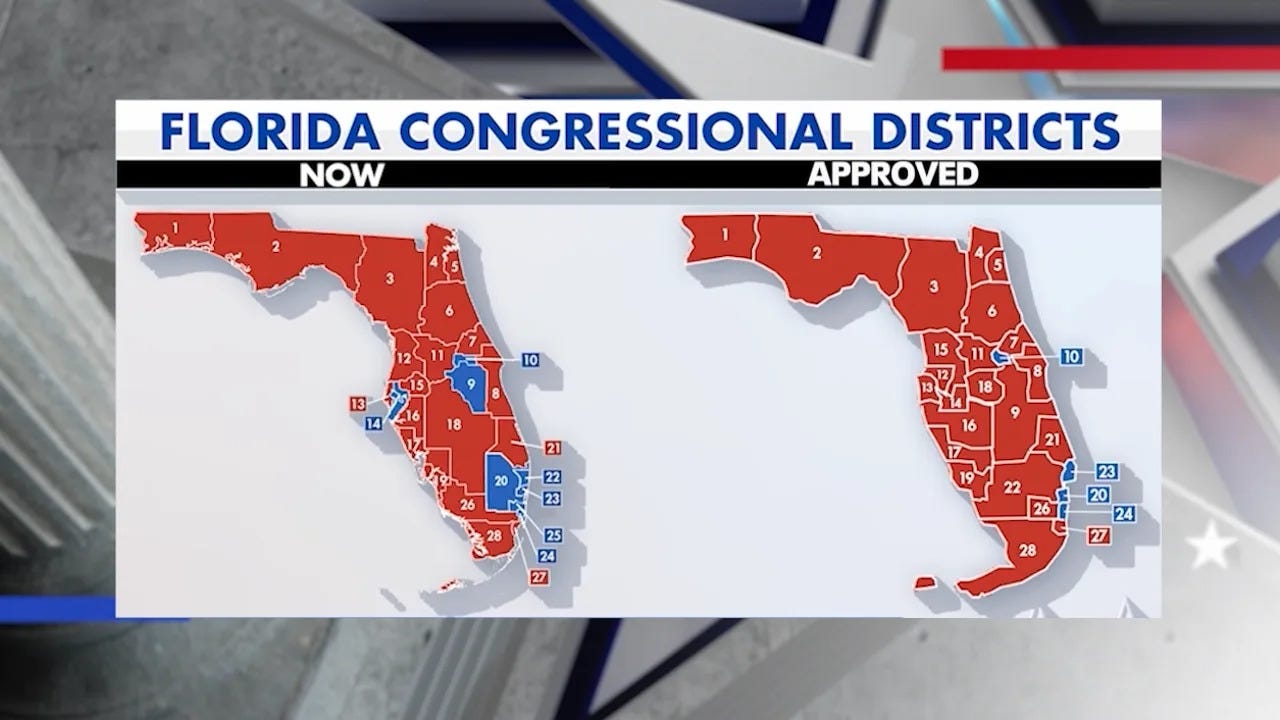
The impact of doing this would shift House seats from Democrats to Republicans in some states—as many as five or more. The immediate response by Gavin Newsom, governor of California, as well as other Democratic governors was to respond in kind: if Trump was going to engineer a basically fraudulent Midterm elections win, they had, they felt, no choice but to beat them at their own game.
But then the plot thickens.
Now the Supreme Court Has Gutted the Voting Rights Act
Into this already complicated state of affairs came a Supreme Court case called Louisiana v. Callais (2026).
Writes NPR:
For decades, the landmark law that came out of the Civil Rights Movement protected the collective voting power of racial minorities when political maps are redrawn. Its provisions have also boosted the number of seats in the House of Representatives filled by Black lawmakers.
That’s largely because in many Southern states — where voting is often polarized between a Republican-supporting white majority and a Democratic-supporting Black minority — political mapmakers have drawn a certain kind of district to get in line with the Voting Rights Act’s Section 2 provisions. In these districts, racial-minority voters make up a population large enough to have a realistic opportunity of electing their preferred candidates.
But at an October hearing last year for the redistricting case about Louisiana’s congressional map, the Supreme Court’s conservative majority appeared inclined to issue this year another in a series of decisions that have weakened the Voting Rights Act — this time its Section 2 protections in redistricting.
That kind of ruling could put at risk at least 15 House districts currently represented by a Black member of Congress, an NPR analysis has found. Each of those districts has a sizable racial-minority population, is in a state where Republican lawmakers control redistricting and, for now at least, is likely protected by Section 2. Factoring in newly redrawn districts in Missouri and Texas, which were not included in NPR’s analysis, could raise the tally of at-risk districts higher.
What would that look like?
The districts in yellow, now non-white-majority districts, would disappear, and their black or Latino elected officials with them.
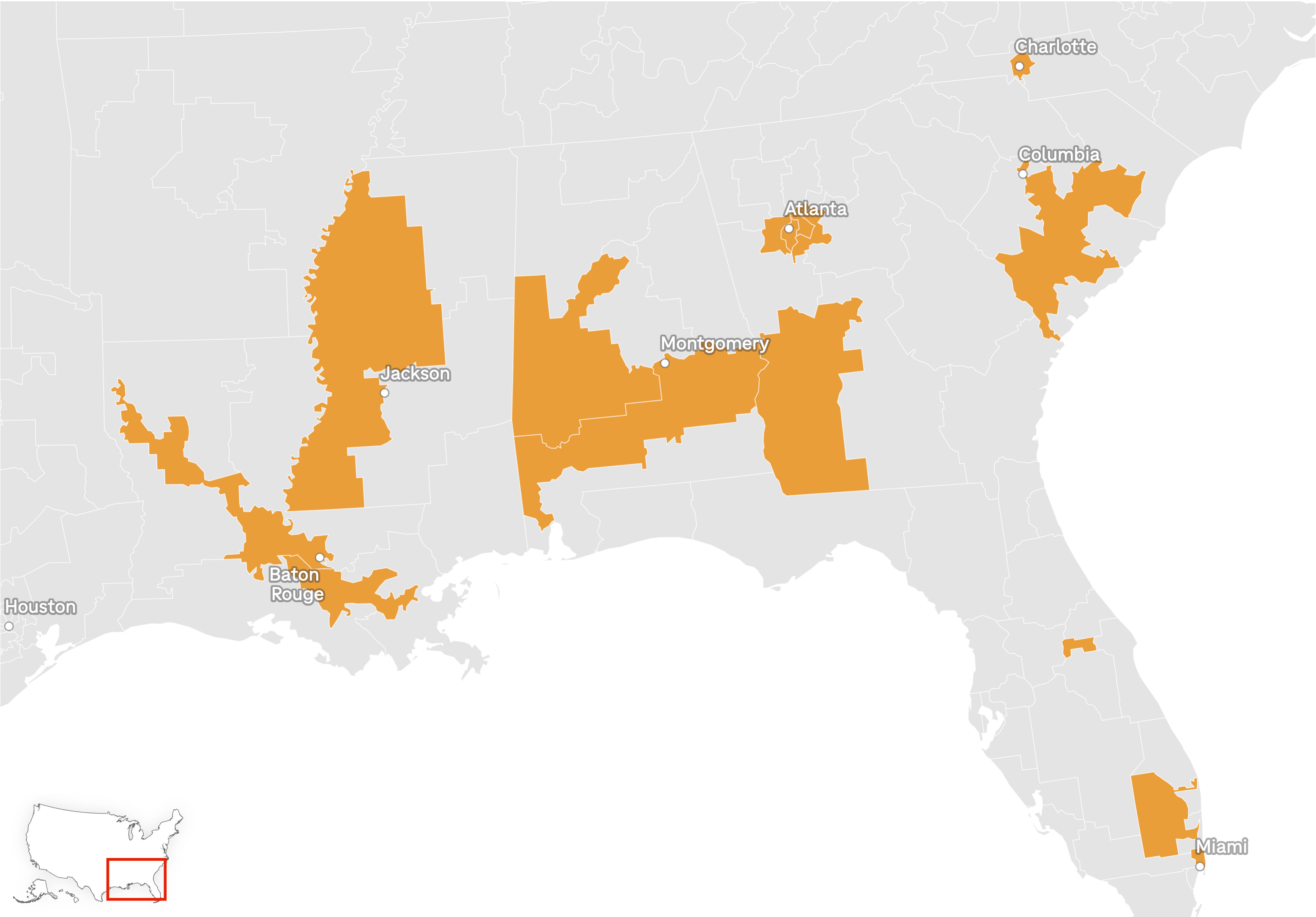
“A Supreme Court ruling could bring historic drop in Black representation in Congress” at https://www.npr.org/2026/01/08/nx-s1-5646525/supreme-court-voting-rights-congressional-black-caucus
There is no such thing as NEUTRAL GROUND in districting. However you district, somebody’s going to get privileged. Where this becomes VERY unfair is in the cases of minorities. Majorities—Whites—will not lose much representation if districts are drawn to conform, roughly, to the percentage of populations in a specific state. In all of the states in the map above, Whites are a majority. If there is no consideration of racial percentages, virtually every Black representative in Congress will go home, replaced by a White representative because Republican White state legislatures will make sure there is NOT ONE district where Blacks CAN elect someone that looks like them.
So, when Samuel Alito—in writing a court majority decision that Robert Reich accurately termed shit—tells you that to create districts based on percentages of racial populations is racial prejudice, it is not: it is an attempt to create a balance of representation as required by the Constitution.
Racial prejudice is making sure that no Black person is ever elected to Congress again by creating districts that always come out MAJORITY WHITE.
Alexis de Tocqueville’s Warning
In warning of the Tyranny of the Majority, de Tocqueville saw this coming. He was wrong about some things. He misread and confused the American legal system with those of England and France, and this resulted in a few mistakes.
But he did not misread the Tyranny of the Majority that has swallowed America whole. He accurately read the ongoing racism in the United States. He predicted the extermination of the Indian nations, and so far they survive, if barely. He predicted that the majority would sideline and disenfranchise the intelligentsia in favor of a deadly mediocrity.
But his most crucial warning is this:
A majority whose omnipotence comes to full flower is a star doomed to fall. In its failures to protect the rights and representations of its minorities are held the seeds of its own destruction. In such a case, it is no longer a majority but a tyranny that is the enemy of all. And in the mirrored reflection of the majority—the rich, the white, the corporate collective, the market—is shown the prettied-up face of the butcher and abuser of masses. No culture can survive that does not protect the most vulnerable among its numbers.
Here endeth the lesson.
PolitiSage Resources on the Supreme Court
The Supreme Court from Hell, Part I

Had I known more of the history I’m about to tell you, I should never have felt as safe with the Supreme Court of the United States as I have. I confess that I always believed they would come through, that they would do what is just. They would stand up for the rights implied by any sane, present-day understanding of …


The Supreme Court from Hell, Part V: Permission to Torture

Our deepest thanks go to those of you who support us with your monthly and yearly subscriptions—or a very divine founding membership. If you’re not already a paid subscriber, we hope you’ll consider becoming one—as the more support we have, the more we can write.
Don’t let this slip from your mind. It’s largely why we’re in such a metric ton of morasses. Keep speaking out. Keeping telling the stories of “nobody’s girls.”
Our deepest thanks go to those of you who support us with your monthly and yearly subscriptions—or a very divine founding membership. If you’re not already a paid subscriber, we hope you’ll consider becoming one—as the more support we have, the more we can write.