
The Doomsday Glacier, Part I: The Thwaites Ice Shelf and global ocean circulation.
The ice shelf that holds back the Thwaites "Doomsday Glacier" will disintegrate before New Years. We'll explain why this could mean a huge sea level emergency--and things far worse.

PolitiSage first published on February 5th, 2023. Now, almost 500 articles later, we need a little help. Please upgrade to a paid subscription if you can. If you can’t, start here, and come join us when you can. [New article continues below the “New Research” reference article.]
https://www.buymeacoffee.com/PolitiSage
New Research: Ocean Current Collapse More Likely, and Sooner, Than We Thought.

For those of you who are Newbies for us, here is out white paper on how the ocean currents work and what has happened before when they shut down. It’s in the public domain, so feel free to pass it around, use it in the classroom (if you’re not arrested for it!), and to keep as a reference.
When we wrote the article above most of a year ago, research showed the ocean circulation around Antarctica to be slowing. As it slows the “chimneys” — great circular gyres that spin the seas—show signs of shutting down. This, the AMOC, the Atlantic Meridional Overturning Circulation, is now coming under serious threat.
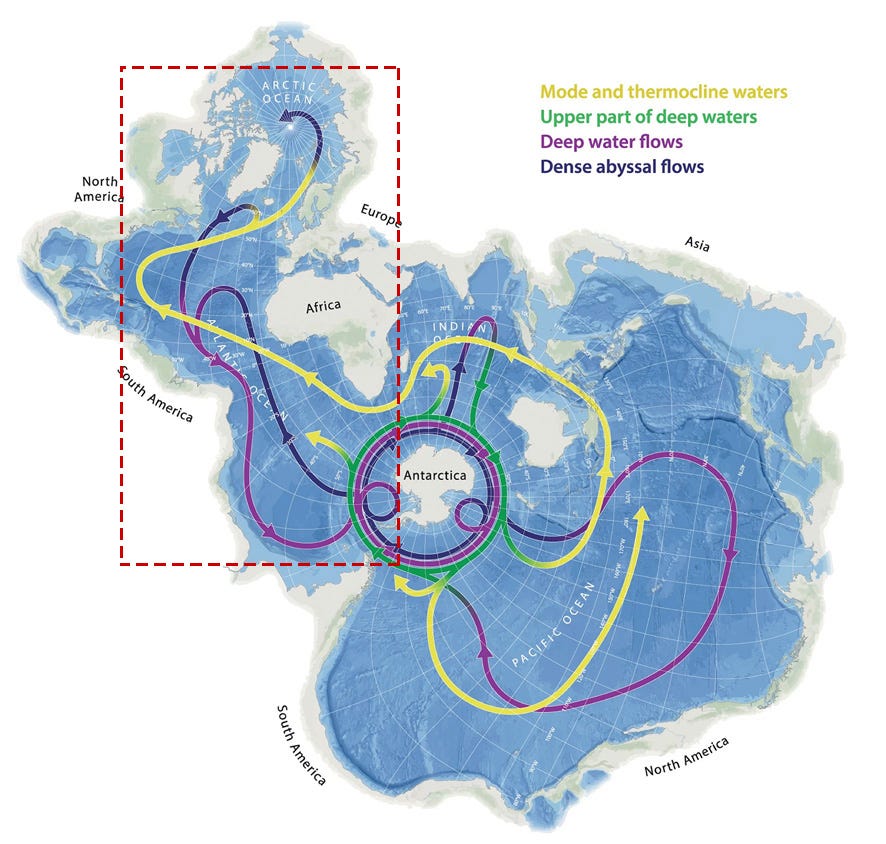
The worldwide ocean current is the reason Earth is not permanently overheated; the currents are also why we are no longer in the last glaciation age. For indeed, when the currents collapse, an ice age develops in as little as 10 months, and much of the Northern Hemisphere is rapidly overtaken by ice.
What causes the currents to stop moving?
The Basics of Thermohaline Circulation
To quote NASA, here’s how this goes:
Deep-ocean currents are driven by differences in the water’s density, which is controlled by temperature (thermo) and salinity (haline). This process is known as thermohaline circulation.
In the Earth’s polar regions ocean water gets very cold, forming sea ice. As a consequence the surrounding seawater gets saltier, because when sea ice forms, the salt is left behind. As the seawater gets saltier, its density increases, and it starts to sink. Surface water is pulled in to replace the sinking water, which in turn eventually becomes cold and salty enough to sink. This initiates the deep-ocean currents driving the global conveyer belt.
Deep-ocean circulation is what keeps the earth’s mean temperature moderate. We have ice at the poles—and we need ice there for just this reason. Ocean circulation helps transport the coolness at the poles to the equatorial regions. Conversely, hurricanes, typhoons, nor’easters and other powerful rotating storms also channel heat from the equatorial regions to the poles, helping to keep the climate temperate. When mean temperatures rise, hurricanes and typhoons become more frequent and more intense in response. The combination of ocean circulation and rotating storms are major parts of the reason Earth enjoys the moderate climate that gives her 3 trillion trees and 8.7 million species of plant and animal life—of which roughly 80% are still undiscovered of which 1 million of which are at risk of extinction from human expansion and deleterious human practices.
Circulation Disrupters
Ocean circulation is an unimaginably powerful force—and it is also incredibly fragile and vulnerable to multiple influences which alone, or in combination, can so disrupt the seawater salinity necessary to drive ocean circulation that the planet’s ocean circulation shuts down. Those factors are:
Melting Polar Glaciers: We’ll get to those ice shelves in a moment, but it’s the glaciers that have the potential to dump massive amounts of fresh water into the ocean, diluting seawater and disrupting density gradients.
Global Warming and Ocean Statification: Rising temperatures can lead to warmer ocean surface waters, affecting circulation patterns. Oceans worldwide have warmed down to 1,500 feet below sea surface. Warmer surface waters can form a layer that inhibits mixing with deeper, colder waters. The best-case scenario is that cold water plunges straight to the earth’s crust.
Increased Precipitation: More rainfall adds freshwater to oceans, altering salinity and density.
Changes in Wind Patterns: Altered wind patterns can impact surface currents, affecting thermohaline circulation. Hurricanes, though they seem to be wind events, can significantly alter surface water temperatures and salinity; they can mix ocean layers in detrimental ways; and their rainfall can disrupt salinity gradient.
Human Activities: Pollution and coastal development can disrupt local ecosystems and water properties, especially close to shorelines.
Polar Glaciers and Their Ice Shelves
We have two frozen poles, and they are significantly different from each other.
The North Pole Ice Cap:
At the Top of the World, the Name of the Game is Albedo.
~
The North Pole Ice Cap is a vast expanse of sea ice over the Arctic Ocean. It fluctuates significantly in size with the seasons. As none of this ice sits on land, it has the same displacement as an iceberg: 90% of the ice is already submerged in the sea, so if it the submerged part of the ice were to melt, it would cause no net gain in sea level. The other 10% of the of the ice is above the water line, so if it were to melt, its volume would be added to the volume in the ocean, thereby contributing to sea level rise.
The great service the North Pole Ice Cap provides comes from its super-high-percentage albedo—albedo being defined as the percentage of the sun’s light radiation that is reflected back out into space. Ice has an almost 95% albedo rate if it’s from pure, uncontaminated snow. That means that the ice reflects back into space 95% of the solar radiation that makes it to its surface.
By contrast, forests have about an albedo rate of about 20%. Grass, 30%. The ocean has a low albedo, typically ranging from 3-10%, meaning the dark-colored ocean absorbs most of the sunlight. As the light rays encounter the ocean, of such a higher material density than the atmosphere, the light radiation is transformed into thermal radiation—heat. Voila! Ocean warming!
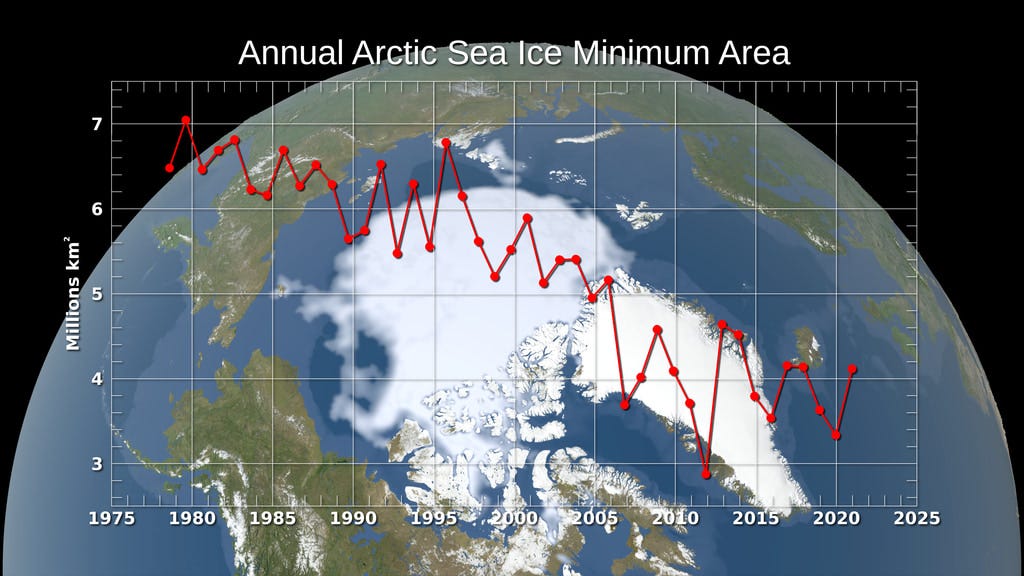
The ice cap has been shrinking over the last 50 years, as oceans have warmed, as shown in the graphic above. As the cap melts, it releases more and more fresh water into the North Atlantic.
The bottom line is that the melting of the North Pole Ice Cap does exponential damage: the loss of albedo accelerates ocean warming which accelerates ice loss. And the melted ice, being freshwater, threatens to desalinate the North Atlantic, destabilizing global thermohaline circulation, a shutdown of which would trigger an ice age.
Antarctica: Ice Sheets, the Thwaites Glacier, and a global thermohaline crisis.
In Part II, we explain what’s going on in Antarctica, what and where the Thwaites Glacier is, and why the loss of its ice shelf portends several major crises.