
Nero? Caligula? Commodus? I'll go with Commodus.
It took the vain, corrupt, cruel, predatory narcissist just 15 years to destroy Rome.

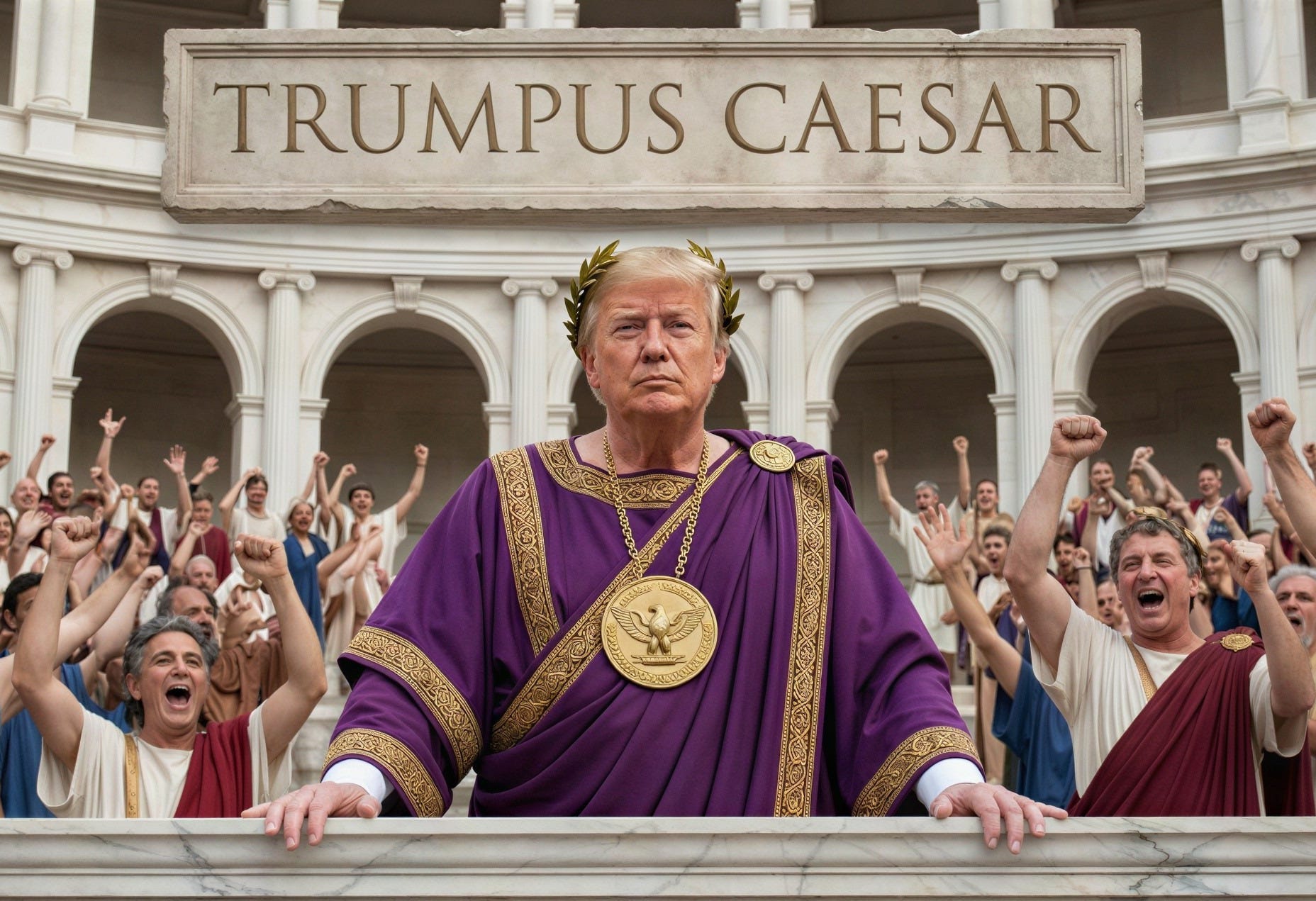
The big risk of posting an image of Trump as an emperor is that he’ll probably love it. After all, we’ve now got a 22-foot golden statue of him on one of his golf courses, a tawdry and very Third Reich-looking arch he plans to build in honor of himself, and a vanity ballroom-in-the-making that rivals even the Oval Office for ersatz golden, tacky, kitschy, tasteless Aryan trash.
Apparently, he thinks nothing through to its natural conclusion:
Even the vainest of us dies. Maybe misbegotten Jesus Impersonators live to see monuments raised to their egos by people with some vested interest like white supremacy, male privilege, and the ability to abuse a 13-year-old girl and get away with it.
But all die. And like those of Nero, like those of Commodus, Trump’s self-glorifying graven images will be torn down by a soon-renascent populace enraged at what he did to a culture that was just barely clawing its way out of the shadows of its quintessentially evil slavery and peonage and Jim Crow laws that kept blacks down and the misogyny that allowed men to deny women the vote, inheritance, financial instruments, work, rightful pay, and control of their own bodies. He will have been the one who snuffed out the light shining on a culture only barely emerging from its dead of winter and dark of night. And everywhere lanterns will begin to glow again.
We will not be forgetting.
Before we get to Trump’s Roman-era doppelganger, we must give due to the Dishonorable Mentions, Caligula and Nero.
Caligula
Caligula (12–41 AD, ruled 37–41). He didn’t start off too shabbily, but he went off the rails early nonetheless. But this may have been largely the result of a nearly fatal fever that may have fried his brain, for when he “came around” he was paranoid, megalomaniacal, murderous, and incredibly cruel. Historian Vedran Bileto notes that “the Senate’s plan to abolish the Roman monarchy failed, but they could attack Caligula. He underwent a “damnatio memoriae,” with his name scrubbed from public monuments and his images taken down.” Caligula did not, however, make his horse a consul, and he did not, as rumored, declare war on the sea. However, there’s a lot to abhor here: He executed and tortured perceived enemies. He declared himself a god and demanded that he be worshiped by his countrymen. He took up incestuous relationships with his sisters, and even ordered the construction of a floating palace for his trysts with his lovers. Worst of all, perhaps, he instituted “bizarre and humiliating public spectacles for entertainment.” He was assassinated at age 28.
Nero
Nero (37–68 AD) had a longer career, ruling from 54-68 CE. Contemporary historians describe Nero, who became emperor of Rome at age 16, as depraved and jealous, a tyrant who sought public acclaim in the theater and arena while ordering the deaths of rivals. He killed his relatives, too, including his mother Agrippina the Younger. He also killed a wife and a raft of public officials and critics. Psychotic, paranoid, and delusional, he was given to extremely depraved behavior and shocking cruelty. He gets a bad rap for fire that destroyed much of Rome: he wasn’t there when it started and didn’t “fiddle while Rome burned.” But when he rebuilt the city, he rebuilt it in his image. He built a statue of himself that was taller than the Statue of Liberty, and had he completed the Palace of Gold, with would have covered 1/3 of the Seven Hills of Rome. While he was bankrupting the empire with a lust for gold (to rival Trump’s and that of the mythic dragon Smaug), he was engaging in some very sketchy behavior: he had a freed slave castrated and then married him. Eventually, revolts broke out all over the empire, but Nero, mad as ever, declared that all he had to do to bring peace, in Gaul and elsewhere, was sing to his enemies.
Not so. Writes Britannica:
The Senate condemned Nero to die a slave’s death: on a cross and under the whip. The Praetorian Guard, his palace guard, abandoned him, and his freedmen left to embark on the ships he kept in readiness at Ostia, the port of Rome. Nero was obliged to flee the city. According to Suetonius, he stabbed himself in the throat with a dagger. According to another version (recounted by Tacitus and almost certainly fiction), he reached the Greek islands, where the following year (69) the governor of Cythnos (modern Kíthnos) recognized him in the guise of a red-haired prophet and leader of the poor, had him arrested, and executed the sentence that had been passed by the Senate.
Nero died at age 30, having ravaged the Roman Empire for 14 years.
Trump and Nero
Now … Perhaps some of the legends of Nero are untrue, but he was bloody awful. And here’s what AI, quoted by Birdyshade, comes up with as the things Nero and Trump have in common. The number of similarities is staggering.
1. Cult of Personality
Both Trump and Nero cultivated personal loyalty over institutional loyalty, surrounding themselves with admirers and dismissing critics.
2. Focus on Spectacle
Nero was known for lavish public performances and spectacles. Trump has been similarly focused on large rallies, media appearances, and dramatic political events.
3. Indifference to Crisis
Nero allegedly “fiddled while Rome burned.” This, we’ve shown, is not true, but Nero was callously indifferent to the people’s welfare during a crisis. Trump was accused of downplaying major crises, such as COVID-19 and political unrest.
4. Populist Appeals
Both appealed to popular classes. Nero gave the Roman populace games; Trump appealed to working-class frustrations. Both also lavish wealth of already-rich and -privileged cronies.
5. Use of Scapegoating
Nero blamed Christians for the Great Fire of Rome. Trump has often blamed immigrants, the media, or political opponents for societal problems.
6. Authoritarian Tendencies
Both demonstrated authoritarian impulses — Nero declared himself above the Senate, and Trump has been accused of undermining democratic institutions.
7. Disdain for Critics
Both leaders were known for aggressively attacking anyone who criticized them — Nero through executions, Trump through public shaming and insults.
8. Self-Aggrandizement
Nero presented himself as a great artist and god-like figure. Trump has been criticized for extreme self-praise and branding everything under his name. Trump also has distributed art making himself look like Jesus Christ.
9. Nepotism and Favoritism
Both were accused of appointing family members and loyalists to high positions regardless of qualifications.
10. Legal Troubles and Investigations
Nero faced numerous conspiracies and accusations. Trump has faced multiple investigations and legal battles and has been found guilt in court of rape and 24 counts of fraud.
11. Polarizing Figures
Both created deep divisions within their societies, fostering an “us vs. them” mentality.
12. Obsession with Image
Nero fancied himself a great actor and musician; Trump is obsessed with media portrayal and his image as a successful businessman. Trump has declared bankruptcy six times and discharged more than a billion dollars in debt in these proceedings.
13. Disregard for Norms
Nero violated traditional Roman political norms. Trump was accused of violating U.S. democratic and political norms.
14. Cultivation of Fear
Both ruled in a way that kept allies and enemies in fear of retaliation or public shaming.
15. Extravagance
Nero built massive palaces (e.g., Domus Aurea). Trump’s ostentatious wealth and golden towers mirror this extravagance.
16. Elitism Disguised as Populism
Despite appealing to common people, both lived lavish lifestyles far removed from ordinary citizens.
17. Paranoia
Both were noted for growing paranoid over time, seeing enemies everywhere.
18. Attacks on the Press
Nero controlled narratives and persecuted writers. Trump labeled unfavorable media “fake news” and “enemies of the people.”
19. Disdain for Established Institutions
Both disregarded traditional institutions of governance — Nero the Senate, Trump various federal institutions.
20. Use of Distraction
Both used grand spectacles and distractions to divert attention from political failures or scandals.
21. Allegations of Corruption
Both faced accusations of corrupt dealings and personal enrichment from their positions.
22. Demagoguery
Both were able to manipulate public opinion through emotionally charged rhetoric.
23. Isolation from Reality
Both became increasingly isolated from reality, surrounded by yes-men and disconnected from ordinary people’s struggles.
24. Desire for Absolute Control
Both figures are associated with efforts to exert personal control over all aspects of government and public life.
25. Politicizing the Judiciary
Nero manipulated courts to punish enemies. Trump has been accused of seeking loyalty from judges and interfering with judicial processes.
26. False Claims of Victimhood
Both portrayed themselves as victims of conspiracies and persecution.
27. Encouraging Violence
Nero’s reign saw brutal crackdowns. Trump was accused of encouraging or not adequately condemning political violence (e.g., January 6th).
28. Loyalty over Competence
Appointments were often based on loyalty rather than expertise under both rulers.
29. Refusal to Accept Defeat
Nero resisted acknowledging declining popularity and impending overthrow. Trump refused to concede the 2020 election.
30. Use of Propaganda
Both made extensive use of propaganda — Nero through art and monuments, Trump through social media and constant campaigning.
31. Endangering the State for Personal Gain
Ultimately, both figures are criticized for putting their own interests above the good of their country, leading to instability and chaos.
Commodus: the Worst of the Worst
We’re not sure that Commodus was actually the son of Marcus Aurelius, the great Stoic philosopher who was the last of Rome’s Five Good Emperors—Nerva, Trajan, Hadrian, Antoninus Pius, and Marcus Aurelius. The FGEs had a habit of adopting their heirs if they weren’t satisfied with the ones who’d come naturally.
Now, the tale told in Gladiator, in which Commodus kills his father, is fiction. Brilliantly played by Richard Harris (Aurelius) and Joaquin Phoenix (Commodus), the ascension to the throne of a vicious Commodus by patricide is a lie: Commodus served as a co-ruler with Marcus Aurelius in the last three years of Aurelius’s reign. He came into this unimaginable power at age 16.
When Marcus Aurelius died in Germania in 180 C.E., Commodus was with him and immediately took up the mantle, becoming sole emperor. After Aurelius had spent years trying to subdue the Germanic tribes ever assaulting Rome’s rim, Commodus rapidly struck a deal with the Marcomanni and Quadi in Germania, declared the conflict over, and promptly returned to Rome to celebrate himself. He began erecting monuments glorifying himself as the god Hercules, fought (probably rigged) gladiatorial contests in the Coliseum, and spent liberal amounts of time with his harem of 300 women.
Things didn’t go well. His excesses and cruelties—he loved watching people being tortured and hearing their agonized screams—were immediately apparent. His sister Lucilla, who had been an Empress of Rome before her husband, Marcus Aurelius’ co-ruler Lucius Veras, was killed, plotted with several senators to kill him. In the movie, of course, Lucilla survives. In real life, the plot to kill Commodus—shooting him at the theater no less!—failed, and the senators were killed. Lucilla was swanned off to the Isle of Capri, where, in the privacy of patrician Roman family life, she was murdered by a Praetorian guard before Saturnalia. So, dear thing did not really live for the sequel, Gladiator II, starring Paul Mescal. More’s the pity.
Anyhow, Commodus became crueler and crueler, and 192 CE, when he’d been emperor for 12 years—and was planning, apparently, to invest himself as consul (consolidating even more power) the next day in the Coliseum—he was strangled to death by one of his Praetorian guards, one named, of all things, Narcissus.
Epic poetic justice, that.
Ultimately, the legacy of Commodus was the destruction of the Pax Romana, which Britannica defines as:
Pax Romana, a state of comparative tranquillity throughout Classical antiquity and the Mediterranean world from the reign of Augustus (27 BCE–14 CE) to the reign of Marcus Aurelius (161 –180 CE). Augustus laid the foundation for this period of concord, which also extended to North Africa and Persia. The empire protected and governed individual provinces, permitting each to make and administer its own laws while accepting Roman taxation and military control.
Commodus inherited a thriving empire with a healthy economy. But Commodus didn’t merely want to rule Rome: he wanted to remake it in his own image. At one point, he even planned to rename Rome itself “Colonia Commodiana.” Months of the year were also renamed after him. It was a striking display of ego that alarmed Rome’s political class and its citizens.
Then Commodus began executing senators he suspected of plotting against him. His erratic behavior also extended into religious persecution. Christians, already endangered, faced surges of violence and repression during his reign.
Inflation rose to 1000% as the imperial economy slid ever downward.
A Safe Presidency Followed by a Length Jail Term and a Thorough Damnatio Memoriae
Trump will not die by assassination—certainly nobody could be stupid enough to do that—or by taking his own life because the present-day Senate is on his heels. He will keep shirking his responsibilities on the golf course while planning more self-congratulatory monuments to himself. He will keep insulting the American public with his self-aggrandizing use of fake gold all over the White House (the trophies aren’t real) and the erection of buildings branded to himself.
Trump will probably die in jail. And then the ballroom will be destroyed or moved and the White House restored. The arch will come down. The reflecting pool will be restored. The gold statue on the golf course will be pulled down, along with those of Confederate “heroes”—and replaced by some of the statues of Civil Rights icons that were ripped off the American landscape in Trump’s war against DEI (his war for all things white).
Then the Damnatio Memoriae of Donald Trump will begin, and he will go down in history—history not made of legend but of contemporary reports and true annals—as the worst president of the United States in its history. And he will join the rest:
Many of Caligula’s monuments were destroyed after his assassination in AD 41. The Senate sought to erase his legacy, leading to the dismantling of his statues. Some monuments were repurposed or incorporated into later structures. Notable examples include the removal of his statue from the Temple of Jupiter. The destruction was part of a broader effort to restore the Republic’s values.
The colossal statue of Nero was destroyed in AD 68, shortly after Nero’s death. It was dismantled by the Emperor Vespasian.
After his death, the Roman Senate declared Commodus a public enemy. They imposed damnatio memoriae, erasing him from history. Statues were destroyed, inscriptions removed, and his name was stripped from public monuments.
If America is not to go the way of Rome after Commodus destroyed it, we’re going to need fight this with every vote we can find—and demand that we are allowed our voting rights—every one of us.
More soon. Thanks for tuning in.
Obviously Morgan is a product of education (emphasized by the Ph.D at the end of his name). However, there are many Ph.D's, with their self serving superiority and greed, mixed w/ a ton of racism, who would be right there with Commodus and Nero, as they are Trump. Somehow we need to educated those who won't read and analyze history. Movies and the arts help. Maybe creators of Video games can be the conduit, because if we leave it to the GOP, they will ban the books and dismantle education to keep the "Plebeians" in the dark.
Thoughtful essay, thanks!
Commodus…perfect name. Trump, and his golden shitter.